
Free Safety Stock Calculator
Calculate your safety stock using the standard Average-Max formula.
Safety Stock Calculator in 3 Simple Steps

1. Gather Data
Collect your sales and lead time data. You'll need your max and average daily usage, plus max and average delivery times.
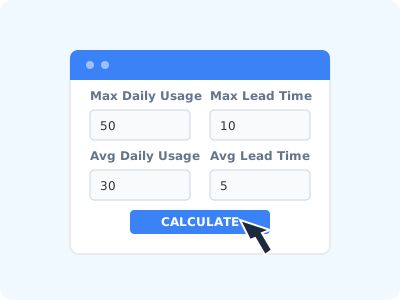
2. Input Data
Enter these 4 numbers into our calculator. It uses the standard Average-Max formula trusted by supply chain pros.
3. Get Result
Instantly see your recommended safety stock level. Use this number to set your new reorder points and prevent stockouts.
What is Safety Stock?
Safety stock is an extra quantity of product that you keep in your inventory to prevent stockouts. Think of it as an insurance policy against uncertainty. Whether it's a sudden spike in customer demand, a delay from your supplier, or a manufacturing glitch, safety stock ensures you can keep fulfilling orders even when things don't go exactly as planned.
Without safety stock, you run the risk of stockouts, which can lead to lost sales, frustrated customers, and even damage to your brand's reputation. On the flip side, holding too much safety stock ties up your cash and increases storage costs. The goal is to find the "sweet spot"—enough to be safe, but not so much that it hurts your bottom line.
Why Do You Need Safety Stock?
There are two main variables that make safety stock necessary:
- Demand Variability: Customers don't buy the exact same amount every day. Some weeks are busy, some are slow. Safety stock covers you during those unexpectedly busy periods.
- Lead Time Variability: Suppliers aren't always perfect. If a shipment that usually takes 5 days takes 10 days to arrive, safety stock bridges that gap so you don't run out while waiting.
How to Calculate Safety Stock: The Formula
The most common and practical way to calculate safety stock is using the Average-Max Formula. It's simple, effective, and doesn't require a degree in statistics.
Here's what each term means:
- Max Daily Usage: The highest number of units you've ever sold in a single day.
- Max Lead Time: The longest time it has ever taken for a shipment to arrive.
- Average Daily Usage: The average number of units you sell per day.
- Average Lead Time: The average time it takes for a shipment to arrive.
Example Calculation
Let's say you sell premium coffee beans.
- On your busiest day, you sold 50 bags (Max Daily Usage).
- The longest you've ever waited for a shipment was 10 days (Max Lead Time).
- On average, you sell 30 bags a day (Average Daily Usage).
- On average, shipments arrive in 5 days (Average Lead Time).
Using the formula:
= 500 - 150
= 350 Bags
So, you should keep 350 bags of coffee as safety stock. This ensures that even if you have your best sales days while experiencing your worst supplier delays, you won't run out of coffee.
Advanced: Statistical Safety Stock Formula
For businesses with high-volume inventory or very erratic demand, a more precise statistical method using standard deviation and service levels might be appropriate. This is often called the standard deviation method.
Where Z is the Z-score for your desired service level (e.g., 1.65 for 95%), σLT is the standard deviation of lead time, and D_avg is average demand. This method is more complex and usually requires inventory management software.
Frequently Asked Questions
What is a good safety stock level?
+There is no single 'good' number because it depends on your industry and risk tolerance. However, a good safety stock level is one that allows you to achieve your desired Service Level (typically 90-95%) without causing excessive carrying costs.
Does safety stock include cycle stock?
+No. Cycle stock is the inventory you sell during regular operations between replenishments. Safety stock is the extra buffer on top of that. Your Reorder Point (ROP) is usually calculated as: Lead Time Demand + Safety Stock.
How often should I recalculate safety stock?
+You should review your safety stock levels regularly—at least quarterly. If your business is seasonal, you might need to adjust it monthly. As your business grows or supplier reliability changes, your safety stock needs will shift.
What is the difference between safety stock and reorder point?
+Safety stock is the buffer inventory kept to prevent stockouts. The Reorder Point (ROP) is the specific inventory level at which you must place a new order to ensure it arrives before you dip into your safety stock. ROP = (Average Daily Usage × Average Lead Time) + Safety Stock.
Need to calculate Stock Turnover?
Check out our Stock Turnover Ratio Guide to learn how fast you're selling your inventory.