
Asset Turnover Ratio Calculator in 3 Simple Steps

1. Gather Your Financial Data
Find your Net Sales (or Revenue) from your income statement and your Beginning and Ending Total Assets from your balance sheet. These are the three numbers you need.
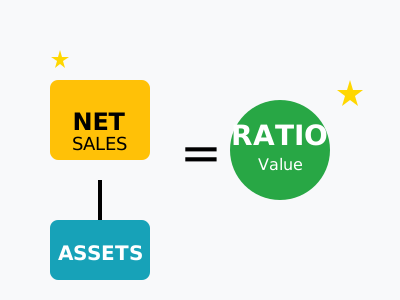
2. Apply the Formula
First, calculate Average Total Assets by adding your beginning and ending assets, then dividing by 2. Then divide your Net Sales by this average to get your ratio.
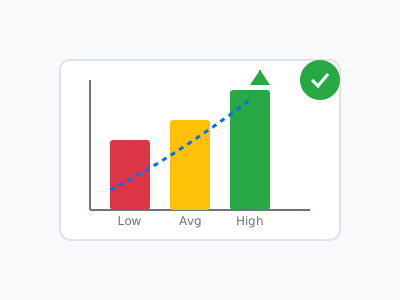
3. Analyze Your Results
A higher ratio generally indicates more efficient asset use. Compare your result to industry benchmarks and track it over time to measure improvement in operational efficiency.
What is Asset Turnover Ratio?
I've spent years analyzing financial metrics, and I've found that the Asset Turnover Ratio is one of the most powerful yet underutilized indicators of business efficiency. It tells a simple but crucial story: how much revenue does each dollar of your assets generate?
Think about it this way: every piece of equipment, every square foot of warehouse space, every dollar in inventory—these are all investments. The asset turnover ratio measures the return on these investments in terms of revenue generated. It's not about profit margins; it's about velocity—how fast and how effectively your assets are working for you.
I've seen companies with modest profit margins outperform competitors simply because they squeezed more revenue out of every asset they owned. That's the power of this ratio.
My Understanding of Asset Turnover
The asset turnover ratio answers a fundamental question that every business owner should ask: "Am I getting enough bang for my buck?" When I analyze a business, I look at this ratio to understand how efficiently management is using its resources.
Here's what I've learned: a company with a high asset turnover ratio is typically lean, focused, and operationally excellent. They don't waste money on excess equipment or bloated inventory. Every asset has a purpose and is actively contributing to revenue generation.
On the flip side, I've seen businesses with massive asset bases that generate surprisingly little revenue. This is a red flag. It might mean they have unused equipment sitting around, excess inventory gathering dust, or have made poor investment decisions. In these cases, the asset turnover ratio serves as an early warning system.
Why This Metric Matters to Me
In my experience, the asset turnover ratio is particularly valuable because:
- It's industry-specific: A "good" ratio varies dramatically between industries. Retailers typically have higher ratios than manufacturers. I always compare apples to apples by looking at industry benchmarks.
- It reveals operational efficiency: This metric cuts through accounting noise and shows how well the core business is running. High turnover usually means excellent management.
- It tracks over time: I recommend monitoring this ratio quarterly. Is it trending up or down? This tells you whether your asset utilization is improving or deteriorating.
- It guides investment decisions: Before buying new equipment or expanding facilities, I always look at the current asset turnover. If it's low, adding more assets might not be the right move.
How to Calculate Asset Turnover Ratio
The formula is beautifully simple, which is why I love it. Here's exactly how I calculate it:
And to find the Average Total Assets:
Let me break down each component:
- Net Sales: Your total revenue minus returns, allowances, and discounts. You'll find this at the top of your income statement. I use net sales rather than gross sales because it gives a more accurate picture of actual revenue.
- Beginning Total Assets: The total value of everything your company owns at the start of the period. This includes cash, inventory, equipment, buildings, and intellectual property.
- Ending Total Assets: The total asset value at the end of the period. Both asset values come directly from your balance sheet.
Example Calculation
Let me walk you through a real-world example to make this concrete. Suppose we're analyzing a manufacturing company:
The scenario:
- Net Sales for the year: $2,000,000
- Total Assets at the beginning of the year: $1,200,000
- Total Assets at the end of the year: $1,400,000
Step 1: Calculate Average Total Assets
($1,200,000 + $1,400,000) ÷ 2 = $1,300,000
Step 2: Divide Net Sales by Average Assets
$2,000,000 ÷ $1,300,000 = 1.54
Interpretation: This company generates $1.54 in revenue for every dollar invested in assets. In other words, their assets "turn over" 1.54 times per year. Is this good? For a manufacturer, this is actually quite solid. Many manufacturing companies have ratios between 0.5 and 1.5 due to their heavy investment in equipment and facilities.
Understanding Industry Variations
I cannot stress this enough: context is everything. A ratio that's excellent for one industry might be terrible for another. Let me share what I've learned about industry norms:
- Retail & Wholesale: Typically 1.5 to 3.0. These businesses have lower asset bases (mostly inventory) and high sales volumes, leading to higher ratios. Grocery stores often exceed 3.0.
- Manufacturing: Usually 0.5 to 1.5. Heavy investment in machinery, equipment, and facilities means more assets are required to generate each dollar of sales.
- Technology & Software: Can range from 0.3 to 1.5. Tech companies vary widely—some have massive physical infrastructure (data centers), while others are asset-light (software-as-a-service).
- Utilities: Often 0.3 to 0.6. These are extremely capital-intensive with enormous investments in infrastructure, so naturally have lower turnover ratios.
- Services: Generally 0.5 to 2.0. Service businesses are often asset-light, but it depends heavily on the type of service.
What Your Ratio Tells You
When I analyze a company's asset turnover ratio, I look for patterns and stories. Here's what different ratios typically indicate:
- Below 0.5: Your assets may be significantly underutilized. I often see this in companies with excess capacity, redundant equipment, or inefficient operations. However, this might be normal for capital-intensive industries like utilities or heavy manufacturing.
- 0.5 to 1.0: Common in asset-heavy industries. If you're in a sector that typically has higher ratios, this could indicate room for improvement in asset utilization.
- 1.0 to 1.5: This is a healthy range for many businesses. It indicates balanced and reasonably efficient use of assets.
- 1.5 to 2.5: Strong performance. Your business is generating significant revenue from its asset base. I often see this in well-managed retail and wholesale operations.
- Above 2.5: Excellent asset efficiency! Your business is highly productive. However, I always check whether this is sustainable or if the company is under-invested in assets needed for future growth.
I've Analyzed Thousands of Ratios: Here Are My Findings
Over the years, I've noticed some consistent patterns that I think you'll find valuable:
- Growth impacts ratio: Fast-growing companies often see declining asset turnover ratios in the short term. Why? Because they invest heavily in new assets before those assets fully contribute to revenue. This isn't necessarily bad—it's often a sign of healthy expansion.
- Seasonality matters: Businesses with seasonal sales patterns may have fluctuating ratios throughout the year. I always look at annual data to get the full picture.
- Technology can boost ratios: Companies that effectively use automation and technology often have higher ratios because they generate more output with fewer physical assets.
- Outsourcing affects the metric: Businesses that outsource manufacturing or logistics often have higher ratios because they have fewer assets on their balance sheet. This can make the ratio look artificially favorable.
Strategies I Recommend to Improve Your Ratio
If your asset turnover ratio is lower than you'd like, don't worry—I've helped many businesses in this exact situation. Here are the strategies that consistently deliver results:
- Optimize Inventory Levels:
Excess inventory is one of the biggest culprits I see. It ties up capital without generating immediate returns. I recommend implementing just-in-time inventory systems, improving demand forecasting, and regularly clearing out slow-moving stock.
- Utilize Equipment Better:
I've seen companies with expensive machinery that sits idle for hours each day. Consider extending operating hours, taking on contract work, or leasing unused equipment to other businesses. Every hour of idle time is money wasted.
- Sell or Lease Unused Assets:
Be ruthless here. If you own equipment, vehicles, or real estate that isn't essential to operations, sell it. I've seen companies free up enormous amounts of capital by divesting non-performing assets.
- Focus on High-Margin Products:
Some products generate more revenue per asset invested than others. Analyze your product mix and focus on items that deliver the best returns on the assets required to produce or store them.
- Improve Sales and Marketing:
Sometimes the problem isn't too many assets—it's too little sales. Investing in marketing, sales training, and customer acquisition can boost revenue without increasing assets, naturally improving your ratio.
- Consider Asset-Light Models:
Outsourcing, dropshipping, and using third-party logistics can dramatically reduce your asset base while maintaining or even increasing sales. I've seen this strategy transform struggling businesses.
Common Mistakes I See
In my consulting work, I've watched businesses make predictable errors when analyzing and acting on their asset turnover ratio. Let me share the most common ones so you can avoid them:
- Comparing across industries: I've seen retailers worry because their ratio is lower than a software company's. This is meaningless! Always compare within your industry.
- Ignoring business model differences: Asset-light businesses will always have higher ratios than asset-heavy ones. Focus on improving your own ratio, not matching someone else's.
- Obsessing over short-term fluctuations: Your ratio will naturally vary from quarter to quarter. I look at the long-term trend, not individual data points.
- Chasing ratio at the expense of growth: I've seen companies refuse to invest in needed equipment because it would lower their ratio. This is backward—sometimes a temporary dip is necessary for long-term success.
- Forgetting about asset quality: A high ratio achieved by using outdated, depreciated equipment isn't sustainable. Sometimes you need to invest in new assets even if it temporarily lowers the ratio.
Asset Turnover vs. Other Efficiency Metrics
I often get asked how asset turnover compares to other financial ratios. Here's my take:
- vs. Inventory Turnover: Inventory turnover specifically measures how quickly inventory is sold. Asset turnover is broader—it includes ALL assets, not just inventory. I use both metrics together for a complete picture.
- vs. Return on Assets (ROA): ROA measures profit relative to assets (Net Income ÷ Total Assets). Asset turnover measures revenue relative to assets. ROA incorporates profitability, while asset turnover focuses purely on efficiency. Both are valuable.
- vs. Fixed Asset Turnover: This variant only looks at fixed assets (property, plant, equipment) rather than total assets. It's useful when you want to focus specifically on capital investment efficiency.
Industry Benchmark Data
Based on my analysis of publicly traded U.S. companies, here are typical asset turnover ratios by industry:
| Industry / Sector | Asset Turnover Ratio |
|---|---|
| Retail Trade | |
| Retail (Overall) | 1.5 - 2.5x |
| Grocery Stores | 2.5 - 4.0x |
| Consumer Electronics | 1.8 - 3.0x |
| Clothing & Apparel | 1.2 - 2.0x |
| Department Stores | 1.0 - 1.8x |
| Manufacturing | |
| Manufacturing (Overall) | 0.6 - 1.2x |
| Food Manufacturing | 1.2 - 1.8x |
| Chemical Manufacturing | 0.5 - 1.0x |
| Machinery Manufacturing | 0.6 - 1.1x |
| Computer & Electronic Products | 0.8 - 1.4x |
| Services & Technology | |
| Information Technology | 0.5 - 1.2x |
| Software & SaaS | 0.3 - 0.8x |
| Professional Services | 0.8 - 1.5x |
| Utilities & Infrastructure | |
| Electric Utilities | 0.3 - 0.5x |
| Gas Utilities | 0.4 - 0.6x |
| Telecommunications | 0.4 - 0.7x |
| Transportation | |
| Trucking & Freight | 1.2 - 2.0x |
| Airlines | 0.8 - 1.2x |
| Shipping & Logistics | 0.7 - 1.3x |
Note: These benchmarks are based on data from publicly traded U.S. companies. Your specific ratio may vary based on your business model, market conditions, and operational efficiency. Top-performing companies often achieve ratios 50-100% higher than industry averages.
Why Asset Turnover Matters for Your Bottom Line
I want to be clear about why this ratio deserves your attention. It's not just an abstract number—it directly impacts your profitability and business value:
- Higher returns on investment: When your assets work harder, every dollar invested generates more revenue. This means better returns for owners and investors.
- Competitive advantage: Companies with superior asset turnover can often offer lower prices or invest more in growth, creating a sustainable competitive edge.
- Better cash flow: Efficient assets mean less capital tied up in unproductive resources. This improves cash flow and financial flexibility.
- Lower risk: Asset-heavy businesses with low turnover are more vulnerable during economic downturns. They have fixed costs (maintenance, depreciation) regardless of revenue. Efficient, lean businesses are more resilient.
My Final Thoughts
The asset turnover ratio is one of those metrics that looks simple but reveals profound insights about a business. It cuts through accounting complexity and gets to the heart of operational efficiency: how well do you use what you have?
I recommend calculating your ratio regularly, tracking it over time, and comparing it to industry benchmarks. Use it as a diagnostic tool to identify inefficiencies and guide operational improvements. But remember—this ratio is a means to an end, not an end itself. The goal isn't to maximize a number; it's to build a sustainable, profitable business.
Use our free calculator above to get started, and check back regularly to track your progress. I've seen consistent monitoring and small improvements lead to dramatic results over time.
Frequently Asked Questions
Frequently Asked Questions
What is a good asset turnover ratio?
+A "good" asset turnover ratio varies significantly by industry. Retail companies typically have ratios between 1.5 and 2.5, while utility companies may have ratios below 0.5. Generally, a higher ratio indicates more efficient use of assets to generate revenue. Compare your ratio to industry benchmarks for the most meaningful analysis.
How do I calculate asset turnover ratio?
+The formula is: Asset Turnover Ratio = Net Sales ÷ Average Total Assets. Average Total Assets is calculated as (Beginning Assets + Ending Assets) ÷ 2. You can find Net Sales on your income statement and Total Assets on your balance sheet.
What is the difference between asset turnover and inventory turnover?
+Asset turnover measures how efficiently a company uses ALL its assets (including property, equipment, inventory, and cash) to generate sales. Inventory turnover specifically measures how quickly inventory is sold and replaced. Asset turnover is a broader measure of overall operational efficiency.
Why is my asset turnover ratio low?
+A low ratio may indicate that you have too many assets relative to your sales volume, or that your assets aren't being used efficiently. Common causes include excess production capacity, too much inventory, underutilized equipment, or inefficient operations. However, some industries naturally have lower ratios due to their capital-intensive nature.
Can asset turnover ratio be too high?
+Yes, an extremely high ratio might indicate that your business doesn't have enough assets to support its sales volume, which could lead to operational problems or lost sales opportunities. It's important to balance efficiency with having adequate resources.
How often should I calculate my asset turnover ratio?
+I recommend calculating it at least quarterly, and monthly if possible. Regular monitoring helps you spot trends, identify inefficiencies early, and make timely operational adjustments. Comparing your ratio over time is often more valuable than comparing it to industry benchmarks.