
Table of contents
Current Ratio Calculator in 3 Simple Steps
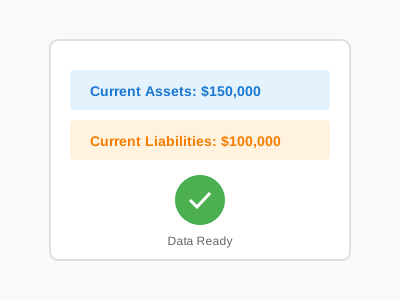
1. Gather Your Financial Data
Find your Current Assets and Current Liabilities from your balance sheet. Current assets include cash, inventory, and accounts receivable. Current liabilities include accounts payable and short-term debt due within one year.
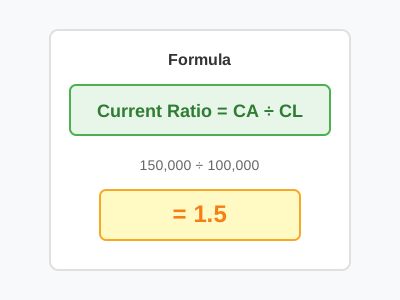
2. Apply the Formula
Divide your Total Current Assets by your Total Current Liabilities. The formula is: Current Ratio = Current Assets ÷ Current Liabilities. This gives you a ratio that shows how many times you can cover your short-term obligations.
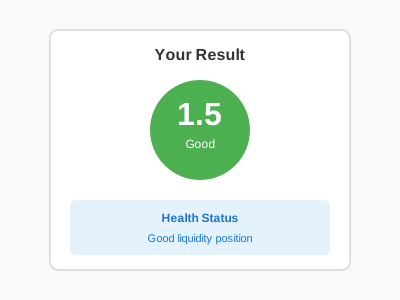
3. Analyze Your Results
A ratio above 1.0 means you can cover your short-term obligations. A ratio between 1.5 and 3.0 is generally considered healthy. Compare your result to industry benchmarks and track it over time to monitor your liquidity position.
What is Current Ratio?
I've analyzed countless financial statements, and I can tell you that the current ratio is one of the most essential liquidity metrics for any business. It answers a fundamental question: "Can I pay my bills?"
The current ratio measures your ability to meet short-term obligations (due within one year) using your short-term assets. Think of it as a litmus test for your financial health in the immediate future. When I see a healthy current ratio, I know a business can weather short-term storms, pay suppliers on time, and seize opportunities that require quick cash.
I've watched businesses with strong current ratios survive economic downturns that crushed their competitors. Why? Because they had the liquidity to stay flexible when credit tightened and customers delayed payments. This ratio isn't just a number—it's your financial cushion.
My Understanding of Current Ratio
The current ratio tells me how many dollars of current assets you have for every dollar of current liabilities. A ratio of 2.0 means you have $2 in current assets for every $1 in current liabilities. That's a comfortable position to be in.
Here's what I've learned from analyzing businesses across different industries:
- A ratio above 1.0: You can cover your short-term obligations. This is the minimum threshold for solvency.
- A ratio between 1.5 and 3.0: This is the sweet spot for most businesses. You have enough liquidity to handle surprises and invest in growth.
- A ratio below 1.0: Warning sign. Your current liabilities exceed your current assets. You may struggle to pay bills on time.
- An extremely high ratio (above 3.0 or 4.0): While this looks good, I always investigate further. It might mean you're holding too much cash that could be invested elsewhere, or you're not managing inventory efficiently.
Why I Take Industry Context Seriously
I've seen business owners panic about their "low" current ratio of 1.2, not realizing that's perfectly normal for their industry. A grocery store can operate successfully with a current ratio of 1.0 because they turn over inventory quickly and collect cash immediately from customers. A manufacturing company might need a ratio of 2.5 because they have significant working capital tied up in raw materials and work-in-progress inventory.
When I analyze current ratios, I always compare apples to apples by looking at industry benchmarks. What's healthy for a software company would be concerning for a heavy machinery manufacturer.
How to Calculate Current Ratio
The formula is beautifully simple, which is why I love it. Here's exactly how I calculate it:
Let me break down each component:
- Current Assets: All assets you expect to convert to cash within one year. This includes cash and cash equivalents, accounts receivable (money customers owe you), inventory, marketable securities, and prepaid expenses. You'll find this at the top of the assets section on your balance sheet.
- Current Liabilities: All obligations due within one year. This includes accounts payable (money you owe suppliers), short-term loans, accrued expenses, taxes payable, and the current portion of long-term debt. This is at the top of the liabilities section on your balance sheet.
Example Calculation
Let me walk you through a practical example to make this concrete. Suppose we're analyzing a retail business:
The scenario:
- Cash: $50,000
- Accounts Receivable: $40,000
- Inventory: $80,000
- Total Current Assets: $170,000
- Accounts Payable: $60,000
- Short-term Debt: $30,000
- Accrued Expenses: $20,000
- Total Current Liabilities: $110,000
Calculation:
Current Ratio = $170,000 ÷ $110,000 = 1.55
Interpretation: This business has $1.55 in current assets for every $1 in current liabilities. This is a healthy current ratio. The business can comfortably meet its short-term obligations and has a buffer for unexpected expenses or short-term investments.
Understanding Your Current Ratio Results
When I analyze current ratios, I look for patterns and context. Here's what different ranges typically indicate:
- Below 1.0: This is a red flag. Your current liabilities exceed your current assets, meaning you may struggle to pay bills on time. I've seen businesses in this position rely heavily on short-term borrowing or delay payments to suppliers, which can damage relationships and lead to cash flow crises.
- 1.0 to 1.5: You can cover your obligations, but there's little room for error. A slight delay in customer payments or an unexpected expense could create problems. I'd recommend building a stronger liquidity buffer.
- 1.5 to 3.0: This is generally the ideal range. You have sufficient liquidity to meet obligations, handle surprises, and invest in opportunities. Most established businesses aim for this range.
- Above 3.0: While this indicates strong liquidity, I always ask: "Could this capital be used more effectively elsewhere?" Excess cash might be better invested in growth initiatives, and excess inventory might indicate overstocking.
Current Ratio vs. Quick Ratio: What's the Difference?
I often get asked about the quick ratio (also called the acid-test ratio). Here's the key difference:
The current ratio includes all current assets, even inventory that might take months to sell. The quick ratio is more conservative—it excludes inventory and prepaid expenses, focusing only on the most liquid assets (cash, marketable securities, and accounts receivable).
I use both ratios together. The current ratio gives me an overall view of liquidity, while the quick ratio tells me about immediate liquidity—can you pay bills RIGHT NOW without relying on selling inventory? For businesses with slow-moving inventory, I pay special attention to the quick ratio.
Industry Benchmark Data
Based on my analysis of publicly traded U.S. companies and industry data, here are typical current ratios by industry:
| Industry / Sector | Current Ratio |
|---|---|
| Retail & Wholesale | |
| Grocery Stores | 1.0 - 1.5x |
| Retail (General) | 1.2 - 1.8x |
| E-commerce & Direct-to-Consumer | 1.3 - 2.0x |
| Wholesale Distribution | 1.4 - 2.0x |
| Manufacturing | |
| Manufacturing (Overall) | 1.5 - 2.5x |
| Food & Beverage Manufacturing | 1.3 - 2.0x |
| Chemical Manufacturing | 1.5 - 2.5x |
| Machinery & Equipment | 1.6 - 2.6x |
| Services & Technology | |
| Software & SaaS | 2.0 - 4.0x |
| IT Services | 1.8 - 3.0x |
| Professional Services | 1.5 - 2.5x |
| Healthcare Services | 1.4 - 2.2x |
| Construction & Real Estate | |
| Construction | 1.3 - 1.8x |
| Real Estate (Development) | 1.5 - 2.5x |
| Transportation & Logistics | |
| Trucking & Freight | 1.2 - 1.8x |
| Airlines | 0.8 - 1.2x |
| Shipping & Logistics | 1.3 - 2.0x |
Note: These benchmarks are based on data from publicly traded U.S. companies. Your specific ratio may vary based on your business model, market conditions, and operational efficiency. Seasonal businesses may experience significant fluctuations throughout the year.
Strategies I Recommend to Improve Your Current Ratio
If your current ratio is lower than you'd like, don't panic—I've helped many businesses strengthen their liquidity position. Here are proven strategies that work:
- Accelerate Accounts Receivable Collection:
Slow-paying customers drain your liquidity. I've seen businesses dramatically improve their current ratio simply by tightening collection policies, offering early payment discounts, and actively following up on overdue invoices. Consider factoring receivables if you need immediate cash.
- Optimize Inventory Levels:
Excess inventory ties up capital that could be used elsewhere. I recommend implementing just-in-time inventory systems, improving demand forecasting, and regularly clearing out slow-moving stock through promotions or discounts. The goal is to maintain enough inventory to meet demand without overstocking.
- Negotiate Better Payment Terms:
Work with suppliers to extend payment terms from 30 to 60 or 90 days. This effectively increases your current assets (since you hold cash longer) relative to your current liabilities. Many suppliers are willing to offer better terms to reliable customers, especially if you've built strong relationships.
- Refinance Short-term Debt:
Convert short-term obligations into long-term debt. This reduces your current liabilities and immediately improves your current ratio. For example, refinancing a short-term loan into a 5-term loan moves that liability from "current" to "long-term."
- Improve Cash Management:
Implement better cash flow forecasting and maintain adequate cash reserves. I've seen businesses with volatile cash flows maintain healthy current ratios by building cash cushions during strong periods to weather lean times.
- Consider Equity Financing:
If you're consistently struggling with liquidity, bringing in equity investors can boost current assets without increasing liabilities. This improves your current ratio and strengthens your overall financial position.
Common Mistakes I See Businesses Make
In my consulting work, I've watched businesses make predictable errors when managing their current ratio. Let me share the most common ones so you can avoid them:
- Obsessing over a high current ratio: I've seen businesses hold excessive cash reserves instead of investing in growth. A current ratio of 5.0 might look safe, but you're probably leaving money on the table.
- Ignoring seasonality: Retailers often have low current ratios before the holiday season and high ratios afterward. Don't make drastic changes based on a single point in time—look at trends and averages.
- Manipulating the ratio artificially: I've seen businesses delay payments or rush collections at year-end just to window-dress their current ratio. This is unsustainable and can damage relationships.
- Comparing across industries: A software company with a 3.5 ratio isn't "better" than a grocery store with a 1.2 ratio. Always compare within your industry.
- Forgetting about the quick ratio: If your business has significant inventory, don't rely solely on current ratio. Your quick ratio might reveal liquidity problems that the current ratio masks.
- Neglecting working capital management: The current ratio is a symptom, not the disease. Focus on improving the underlying operations: collections, inventory management, and payment terms.
Why Current Ratio Matters for Your Business
I want to be clear about why this ratio deserves your attention. It's not just about pleasing lenders or investors—it's about business survival and success:
- Creditworthiness: Banks and suppliers look at your current ratio when deciding whether to extend credit. A healthy ratio means better terms, lower interest rates, and stronger business relationships.
- Operational flexibility: When you have good liquidity, you can seize opportunities—buying inventory at a discount, investing in marketing, or acquiring a competitor. Poor liquidity means you're always in reactive mode, struggling to keep up.
- Stress resilience: Economic downturns, supply chain disruptions, or unexpected expenses hit businesses with poor current ratios the hardest. Having liquidity gives you time to adapt and make strategic decisions rather than desperate ones.
- Investor confidence: Whether you're seeking venture capital, preparing for an IPO, or just want to attract strategic partners, a healthy current ratio signals financial discipline and stability.
- Peace of mind: Sleep better at night knowing you can meet payroll, pay suppliers, and handle emergencies. Running a business is stressful enough without constantly worrying about making payroll.
Current Ratio vs. Working Capital: What's the Difference?
I mentioned this earlier, but let me clarify because there's often confusion. Both metrics measure liquidity, but in different ways:
- Current Ratio: A proportion or ratio. Current Assets ÷ Current Liabilities. Useful for comparing businesses of different sizes and tracking trends over time.
- Working Capital: An absolute dollar amount. Current Assets − Current Liabilities. Useful for understanding how much capital you have available for day-to-day operations and growth investments.
I use both metrics together. The current ratio tells me about proportional liquidity, while working capital tells me about the actual dollar amount of liquid resources available. For example, a business with $10 million in assets and $5 million in liabilities has the same current ratio (2.0) as a business with $100,000 in assets and $50,000 in liabilities—but very different working capital and very different operational realities.
How Often Should I Calculate My Current Ratio?
I recommend calculating your current ratio monthly, at minimum. Why so frequently? Because liquidity can change quickly. A large customer payment, a major inventory purchase, or a loan repayment can significantly impact your ratio in just one month.
Here's the monitoring approach I recommend:
- Monthly: Calculate current ratio and compare to previous months and budget. Look for trends and anomalies.
- Quarterly: Perform deeper analysis. Compare to industry benchmarks, analyze the components (accounts receivable aging, inventory turnover, accounts payable terms), and adjust strategies as needed.
- Annually: Review multi-year trends and assess whether your target current ratio needs adjustment based on business changes, industry conditions, and strategic goals.
My Final Thoughts
The current ratio is one of those deceptively simple metrics that reveals profound insights about your business. It's not just about math—it's about your ability to survive and thrive in the short term.
I've seen businesses with brilliant products and strong sales fail because they neglected liquidity management. I've also seen modest businesses thrive because they maintained healthy current ratios and could weather storms and seize opportunities that their over-leveraged competitors couldn't.
Use our free calculator above to check your current ratio right now. Then, commit to regular monitoring and continuous improvement. A healthy current ratio isn't achieved overnight—it's the result of consistent, disciplined financial management across accounts receivable, inventory, and accounts payable.
Remember: the goal isn't to maximize this ratio at all costs. It's to find the right balance between liquidity and efficiency for your specific business, industry, and stage of growth. Use the current ratio as a tool for insight and improvement, not as an end in itself.
Frequently Asked Questions
What is a good current ratio?
+A good current ratio typically falls between 1.5 and 3.0. This indicates you have enough current assets to cover your current liabilities with a comfortable buffer. A ratio below 1.0 suggests potential liquidity problems, while a ratio above 3.0 might mean you're not using your current assets efficiently. However, ideal ratios vary by industry—retail businesses often operate successfully with lower ratios, while service companies may need higher ratios.
How do I calculate current ratio?
+The formula is straightforward: Current Ratio = Current Assets ÷ Current Liabilities. Simply find your total current assets (cash, inventory, accounts receivable, etc.) and divide by your total current liabilities (accounts payable, short-term debt, etc.). Both numbers are found on your balance sheet.
What's the difference between current ratio and quick ratio?
+The current ratio includes all current assets, including inventory which may not be easily convertible to cash. The quick ratio (or acid-test ratio) excludes inventory and prepaid expenses, focusing only on the most liquid assets like cash and accounts receivable. The quick ratio provides a more conservative measure of immediate liquidity. Current Ratio = (Cash + Inventory + Receivables) ÷ Current Liabilities, while Quick Ratio = (Cash + Receivables) ÷ Current Liabilities.
Why is my current ratio low?
+A low current ratio (below 1.0) means your current liabilities exceed your current assets. Common causes include high short-term debt, slow collections from customers, excess inventory that's not selling, or poor cash management. This can make it difficult to pay bills on time and may signal potential liquidity problems that need immediate attention.
Can current ratio be too high?
+Yes, absolutely. While a high current ratio indicates strong liquidity, an extremely high ratio (above 3.0 or 4.0) might suggest you're not using your assets efficiently. You could have excess cash sitting idle when it could be invested, too much inventory tying up capital, or poor receivables collection. The goal is to find the right balance between liquidity and efficiency.
How often should I calculate my current ratio?
+I recommend calculating it monthly, at minimum quarterly. This metric can change quickly as you pay bills, collect receivables, or take on new debt. Regular monitoring helps you spot trends, anticipate cash flow problems before they become critical, and make better operational decisions. Many businesses track it as part of their monthly financial dashboard.
What items are included in current assets?
+Current assets include assets that can be converted to cash within one year. This typically includes: cash and cash equivalents, accounts receivable (money owed by customers), inventory (raw materials, work-in-progress, finished goods), marketable securities, prepaid expenses, and other liquid assets. These are all assets you expect to use up or convert to cash in the next 12 months.
What items are included in current liabilities?
+Current liabilities include obligations due within one year. This includes: accounts payable (money you owe suppliers), short-term debt and loans, accrued expenses, taxes payable, dividends payable, the current portion of long-term debt, and other short-term obligations. These are debts and obligations you must settle in the next 12 months.
How does current ratio vary by industry?
+Current ratio varies significantly by industry. Retail and grocery stores often have lower ratios (1.0-1.5) due to fast inventory turnover. Manufacturing companies typically have higher ratios (1.5-2.5) because they need more working capital. Service businesses may have the highest ratios (2.0-4.0) since they require less inventory. Always compare your ratio to industry benchmarks, not arbitrary standards.
What's the difference between current ratio and working capital?
+Current ratio is a ratio (proportion), while working capital is an absolute dollar amount. Working Capital = Current Assets - Current Liabilities. Current Ratio = Current Assets ÷ Current Liabilities. Working capital tells you how much money you have available for day-to-day operations after paying short-term debts. The current ratio tells you the proportion of assets to liabilities, making it easier to compare across companies of different sizes.