
Table of contents
Return on Equity Calculator in 3 Simple Steps
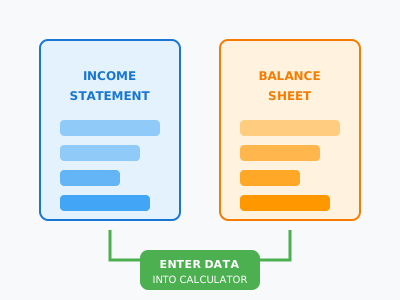
1. Find Your Financial Data
Locate your Net Income from the income statement (profit after all expenses and taxes). Find Shareholders' Equity from the balance sheet (total assets minus total liabilities). Both figures are essential for calculating ROE.
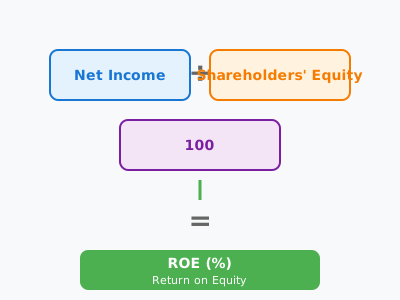
2. Apply the Formula
Divide Net Income by Shareholders' Equity and multiply by 100 to get the percentage. The formula is: ROE (%) = (Net Income ÷ Shareholders' Equity) × 100. This shows what percentage return the company generates on shareholder capital.
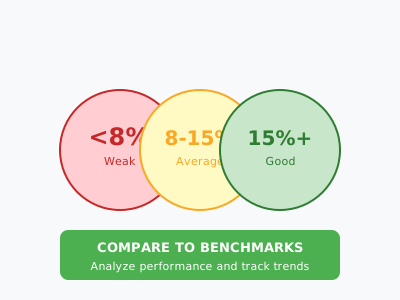
3. Analyze Your Results
An ROE between 15% and 20% is generally considered good, indicating efficient use of shareholder capital. Compare your result to industry benchmarks and track trends over time to assess your company's profitability performance.
What is Return on Equity (ROE)?
After analyzing countless financial statements, I can tell you that return on equity (ROE) is one of the most critical profitability metrics for investors and business owners. It answers a fundamental question: "How well is my company using shareholder money to generate profit?"
ROE measures a company's profitability by revealing how much profit a company generates with the money shareholders have invested. It's expressed as a percentage, making it easy to compare companies of different sizes. When I see a healthy ROE, I know management is efficiently deploying shareholder capital to create value.
I've watched companies with strong ROE consistently outperform their competitors in stock returns and business growth. Why? Because high ROE indicates sustainable competitive advantages, operational excellence, and management that knows how to squeeze maximum profit from every dollar of equity.
My Understanding of Return on Equity
Return on equity tells me what percentage return my company is generating on the capital invested by shareholders. An ROE of 20% means the company generates $0.20 of profit for every $1 of shareholder equity. That's a powerful number—it directly measures how efficiently you're using investor money.
Here's what I've learned from analyzing businesses across different industries:
- An ROE above 20%: Exceptional performance. The company is generating outstanding returns on shareholder capital. Common in technology, software, and asset-light businesses.
- An ROE between 15% and 20%: Strong performance. The company efficiently uses shareholder equity to generate profit. This is the target range for most healthy businesses.
- An ROE between 8% and 15%: Average performance. The company is profitable but may not be maximizing shareholder value. There's room for improvement.
- An ROE below 8%: Weak performance. The company generates poor returns relative to shareholder equity. This suggests operational inefficiencies or unfavorable industry conditions.
- Negative ROE: The company is losing money. This is a red flag requiring immediate investigation and action.
Why I Take Industry Context Seriously
I've seen investors misjudge companies by ignoring industry norms when evaluating ROE. A bank with 12% ROE might be performing excellently, while a software company with 12% ROE might be underperforming. Capital-intensive industries like utilities and manufacturing typically have lower ROEs (8-12%) due to the substantial assets required. Technology and service companies often have higher ROEs (20%+) because they require less physical capital.
When I analyze ROE, I always compare against industry benchmarks and peer companies. What's exceptional for a utility company might be mediocre for a software business. Context is everything.
How to Calculate Return on Equity
The ROE formula is beautifully straightforward, which is why I love it as a quick diagnostic tool. Here's exactly how I calculate it:
Let me break down each component:
- Net Income: The company's profit after all expenses, taxes, and interest have been deducted. This is the "bottom line" profit found on the income statement. It represents what's left over for shareholders.
- Shareholders' Equity: The total ownership interest in the company. Calculated as Total Assets minus Total Liabilities. Found on the balance sheet, it includes common stock, retained earnings, and other equity components.
Example Calculation
Let me walk you through a practical example to make this concrete. Suppose we're analyzing a manufacturing company:
The scenario:
- Revenue: $5,000,000
- Operating Expenses: $3,500,000
- Interest Expense: $200,000
- Taxes: $260,000
- Net Income: $1,040,000
- Total Assets: $6,000,000
- Total Liabilities: $3,500,000
- Shareholders' Equity: $2,500,000
Calculation:
ROE = ($1,040,000 ÷ $2,500,000) × 100 = 41.6%
Interpretation: This company generates a 41.6% return on shareholder equity—this is exceptional performance. The company is extremely efficient at converting shareholder capital into profit. However, I would investigate whether this ROE is sustainable or inflated by one-time gains, excessive leverage, or accounting anomalies.
Understanding Your ROE Results
When I analyze ROE, I look beyond the headline number to understand what's driving it. Here's what different ranges typically indicate:
- Negative ROE: The company is losing money. This could be temporary (startup phase, restructuring) or systemic (declining business). I investigate the cause and assess turnaround potential before investing.
- 0% to 8%: Poor returns. The company generates minimal profit relative to shareholder equity. This might indicate operational inefficiencies, competitive pressures, or industry headwinds. I'd look for improvement plans.
- 8% to 15%: Moderate returns. The company is profitable but not exceptional. This is common in mature, capital-intensive industries. I assess whether the company can improve efficiency or if this is the industry norm.
- 15% to 20%: Strong returns. The company efficiently uses shareholder capital. This indicates competitive advantages, good management, and a solid business model. This is my target range for most investments.
- Above 20%: Exceptional returns. The company generates outstanding profits on shareholder equity. Common in high-margin businesses with strong brands or unique advantages. I investigate sustainability—is this maintainable or temporary?
ROE vs. ROA: What's the Difference?
I often get asked about the difference between ROE and ROA (Return on Assets). Here's the key distinction:
ROE measures profitability relative to shareholders' equity—how well you use money invested by owners. ROA measures profitability relative to total assets—how efficiently you use all assets regardless of whether they were funded by debt or equity.
The relationship between ROE and ROA reveals a lot about financial leverage. If ROE is significantly higher than ROA, it means the company is using debt to boost shareholder returns. This can be good (moderate, strategic debt) or bad (excessive leverage increasing risk). I always look at both metrics together to understand whether high ROE comes from operational excellence or financial engineering.
The DuPont Analysis: Breaking Down ROE
One of my favorite analytical tools is the DuPont analysis, which breaks ROE into three components:
Or more precisely:
This breakdown is incredibly powerful because it tells you why your ROE is what it is:
- Net Profit Margin: How much profit you generate from each dollar of sales. Operational efficiency and pricing power.
- Asset Turnover: How efficiently you use assets to generate sales. Asset utilization and productivity.
- Financial Leverage: How much debt you use to finance assets. Capital structure and financial risk.
I use DuPont analysis to diagnose ROE. If ROE is declining, is it due to shrinking margins (pricing pressure, rising costs), declining asset turnover (inefficient operations), or changing leverage (debt reduction)? This insight helps me pinpoint the root cause and develop targeted solutions.
Industry Benchmark Data
Based on my analysis of publicly traded U.S. companies and industry data, here are typical ROE ranges by industry:
| Industry / Sector | Typical ROE Range |
|---|---|
| Technology & Software | |
| Software & SaaS | 20% - 35%+ |
| Semiconductors | 15% - 25% |
| IT Services | 18% - 28% |
| Technology Hardware | 12% - 20% |
| Financial Services | |
| Banks | 10% - 15% |
| Insurance | 8% - 14% |
| Asset Management | 15% - 25% |
| Investment Banking | 12% - 20% |
| Consumer & Retail | |
| Retail (General) | 12% - 20% |
| Luxury Goods | 15% - 25% |
| Food & Beverage | 10% - 18% |
| Consumer Staples | 12% - 18% |
| Healthcare | |
| Pharmaceuticals | 15% - 25% |
| Biotechnology | 5% - 20%+ |
| Medical Devices | 12% - 20% |
| Healthcare Services | 10% - 18% |
| Industrial & Manufacturing | |
| Manufacturing (General) | 10% - 16% |
| Aerospace & Defense | 12% - 20% |
| Chemicals | 10% - 18% |
| Construction | 8% - 15% |
| Energy & Utilities | |
| Oil & Gas | 8% - 15% |
| Renewable Energy | 5% - 12% |
| Electric Utilities | 8% - 12% |
| Gas Utilities | 8% - 12% |
| Telecommunications | |
| Telecom Services | 10% - 18% |
| Wireless Carriers | 12% - 20% |
Note: These benchmarks are based on data from publicly traded U.S. companies. Your specific ROE may vary based on your business model, market conditions, and operational efficiency. Top-performing companies often achieve ROEs 50-100% higher than industry averages. Some outliers may have ROEs above 40% due to unique competitive advantages or favorable market conditions.
Strategies I Recommend to Improve Your ROE
If your ROE is lower than you'd like, don't panic—I've helped many businesses boost their returns on equity. Here are proven strategies that work:
- Improve Profit Margins:
The most direct way to boost ROE is to increase net income. Focus on pricing strategies, cost reduction, operational efficiency, and product mix optimization. Even a 1-2% improvement in profit margins can significantly impact ROE. I've seen companies transform their ROE by targeting high-margin products, eliminating low-margin customers, and implementing lean practices.
- Optimize Asset Utilization:
Increase asset turnover by generating more sales from existing assets. This might involve improving inventory management, speeding up collection of receivables, or extending payment terms with suppliers. Higher asset turnover (a component of ROE in the DuPont analysis) directly improves ROE by making every dollar of assets work harder.
- Manage Capital Structure Strategically:
Carefully use debt to replace equity in your capital structure. Since ROE = Net Income ÷ Equity, reducing equity (through share buybacks or debt financing) mathematically increases ROE—all else equal. However, be cautious: excessive debt increases financial risk and can backfire. I recommend moderate, strategic use of debt rather than leverage extremes.
- Share Buybacks:
When shares are undervalued, repurchasing shares reduces shareholders' equity (since treasury stock is subtracted from equity). This can boost ROE if earnings remain stable. However, I only recommend this when shares are genuinely undervalued and the company has excess cash—otherwise, you're artificially inflating ROE at the expense of long-term financial health.
- Focus on High-Return Business Lines:
Shift capital from low-ROE business units to high-ROE opportunities. I've seen conglomerates dramatically improve overall ROE by divesting underperforming divisions and doubling down on their most profitable segments. This requires honest assessment of which business units truly create shareholder value.
- Reduce Non-Performing Assets:
Sell or dispose of assets that aren't generating adequate returns. Idle equipment, excess real estate, or underutilized facilities increase the asset base without contributing proportionately to earnings. Streamlining the asset base improves both ROE and ROA.
Common Mistakes I See Businesses Make
In my consulting work, I've watched businesses make predictable errors when managing and interpreting ROE. Let me share the most common ones so you can avoid them:
- Obsessing over ROE at the expense of risk: I've seen companies take on dangerous levels of debt just to boost ROE. High ROE driven by excessive leverage is unsustainable and can lead to bankruptcy during downturns. Always evaluate ROE alongside debt-to-equity ratios and interest coverage.
- One-time gains distorting ROE: Selling a subsidiary or realizing a large investment gain can temporarily inflate ROE. I adjust for one-time items to understand the underlying, sustainable ROE. Don't let a single event mask operational mediocrity.
- Share buybacks at inflated prices: Buying back overpriced shares destroys shareholder value even if it boosts ROE. I only recommend buybacks when shares are genuinely undervalued and the company has better uses for its cash.
- Ignoring industry context: A 12% ROE might be terrible for a software company but excellent for a utility. Always benchmark against industry peers and understand why your ROE differs from competitors.
- Negative equity making ROE meaningless: When shareholders' equity is negative (liabilities exceed assets), ROE becomes meaningless or misleading. In this case, I focus on return on invested capital (ROIC) or return on assets (ROA) instead.
- Over-leveraging during good times: It's easy to boost ROE with debt when profits are strong. But when the cycle turns, high leverage becomes a burden. I advocate for maintaining a conservative capital structure through the entire business cycle.
Why ROE Matters for Investors and Business Owners
I want to be clear about why ROE deserves your attention. It's not just about impressing analysts—it's about understanding value creation:
- Measuring management effectiveness: ROE directly measures how well management uses shareholder capital to generate profit. High ROE indicates competent, efficient management. Low ROE suggests capital misallocation or operational problems.
- Comparative analysis: ROE allows you to compare companies of different sizes. A small company with 25% ROE might be creating more value per dollar of equity than a giant with 10% ROE. This levels the playing field for analysis.
- Valuation insights: Companies with sustainably high ROE often trade at higher price-to-book ratios because investors are willing to pay more for businesses that efficiently generate returns on equity. Understanding ROE helps you identify overvalued and undervalued stocks.
- Capital allocation decisions: For business owners, ROE helps decide where to invest capital. Business units with high ROE deserve more investment. Low-ROE units should be restructured or divested. ROE guides capital to its highest-value use.
- Performance tracking: Monitoring ROE over time reveals whether your business is becoming more or less efficient at generating profit from equity. Declining ROE is an early warning sign of competitive pressure or operational decline.
Limitations of ROE: When to Look Beyond the Number
While I love ROE as a metric, it has important limitations you must understand:
- Debt leverage distortion: ROE doesn't account for debt. Companies can artificially inflate ROE by taking on excessive debt (which reduces equity). This is why I always look at ROE alongside debt ratios and ROA.
- Risk blindness: High ROE doesn't consider risk. A company with 30% ROE taking dangerous risks might be inferior to a company with 15% ROE and conservative strategy. Risk-adjusted returns matter more than raw returns.
- Negative equity: When equity is negative, ROE becomes meaningless or can be artificially high. In these cases, use return on invested capital (ROIC) instead.
- One-time items: Asset sales, accounting changes, or legal settlements can distort ROE temporarily. I always adjust for non-recurring items to understand underlying performance.
- Industry dependence: ROE varies dramatically by industry due to capital intensity and business models. Comparing ROE across unrelated industries is meaningless. Always benchmark against industry peers.
- Backward-looking: ROE measures past performance, not future potential. A company with declining but still-high ROE might be facing headwinds that aren't yet reflected in the metric. Combine ROE with forward-looking analysis.
My Final Thoughts
Return on Equity is one of those metrics that strikes the perfect balance between simplicity and insight. It's easy to calculate but reveals profound truths about how well a company serves its shareholders.
I've seen high-ROE compound machines create generational wealth for investors. I've also watched low-ROE businesses destroy value despite growing revenue. The difference often comes down to how efficiently management converts shareholder capital into profit.
Use our free calculator above to check your ROE right now. Then, commit to understanding what drives your ROE—whether it's profit margins, asset turnover, or capital structure. Remember: the goal isn't to maximize ROE at all costs through risky leverage or accounting tricks. It's to build a sustainable business that consistently generates excellent returns on shareholder capital while managing risk prudently.
A sustainable 15-20% ROE, achieved through operational excellence rather than financial engineering, is a beautiful thing. It's a sign of a business with competitive advantages, skilled management, and a bright future. That's the kind of ROE worth striving for.
Frequently Asked Questions
What is a good return on equity (ROE)?
+A good ROE typically falls between 15% and 20%. This indicates efficient use of shareholder capital and strong profitability. An ROE above 20% is considered exceptional, while an ROE below 8% is generally considered weak. However, ideal ROE varies significantly by industry—technology companies often have higher ROEs (20%+), while utilities and capital-intensive industries may have lower but still acceptable ROEs (8-12%). Always compare your ROE to industry benchmarks for meaningful analysis.
How do I calculate return on equity?
+The formula is straightforward: ROE (%) = (Net Income ÷ Shareholders' Equity) × 100. Net Income is found on your income statement (profit after all expenses and taxes). Shareholders' Equity is found on your balance sheet (total assets minus total liabilities). Simply divide net income by shareholders' equity and multiply by 100 to get the percentage.
What's the difference between ROE and ROA?
+ROE (Return on Equity) measures profitability relative to shareholders' equity, while ROA (Return on Assets) measures profitability relative to total assets. ROE shows how well you use investor money, while ROA shows how efficiently you use all assets regardless of funding source. ROE is typically higher than ROA because equity is usually smaller than total assets. ROE is more relevant for shareholders, while ROA is useful for evaluating overall operational efficiency.
Why is my ROE low?
+A low ROE (below 8-10%) suggests your company isn' generating sufficient profit relative to the equity invested. Common causes include low net margins, inefficient asset utilization, excessive equity base, or declining profitability. It could also indicate you're holding too much equity relative to earnings, which might suggest you should return capital to shareholders or find more profitable investment opportunities.
Can ROE be too high?
+Yes, absolutely. While a high ROE indicates strong profitability, an extremely high ROE (above 30-40%) might signal excessive debt leverage rather than operational excellence. Since ROE doesn' account for debt levels, a company can boost ROE by taking on more debt (which reduces equity). This is why I always look at ROE alongside debt ratios and ROA. Very high ROE in a low-margin business warrants investigation.
How often should I calculate ROE?
+I recommend calculating ROE quarterly at minimum. Annual ROE is the standard metric for investors, but quarterly monitoring helps you spot trends and make timely operational adjustments. Publicly traded companies report ROE annually in their 10-K filings. For private businesses, tracking ROE quarterly helps you assess whether you're generating adequate returns for your shareholders.
What is DuPont analysis?
+DuPont analysis breaks down ROE into three components: ROE = (Net Income ÷ Revenue) × (Revenue ÷ Total Assets) × (Total Assets ÷ Shareholders' Equity). In simpler terms: ROE = Net Profit Margin × Asset Turnover × Financial Leverage. This breakdown helps you understand whether your ROE is driven by operational efficiency (profit margins and asset turnover) or financial leverage (debt). It's a powerful diagnostic tool I use frequently.
What items are included in shareholders' equity?
+Shareholders' equity includes: Common stock and preferred stock (the capital invested by shareholders), Additional paid-in capital (the amount shareholders paid above par value), Retained earnings (accumulated profits that weren't distributed as dividends), Treasury stock (shares the company repurchased, subtracted), and Other comprehensive income (gains/losses not included in net income). You'll find this on the balance sheet as total assets minus total liabilities.
How does ROE vary by industry?
+ROE varies significantly by industry due to different capital structures and business models. Technology and software companies often have ROEs of 20-30%+ due to low capital requirements. Banks typically target 12-15% ROE as a key profitability metric. Retailers often have 15-20% ROE. Utilities and heavy manufacturing may have 8-12% ROE due to high capital intensity. Always compare your ROE to industry peers, not arbitrary standards.
What are the limitations of ROE?
+ROE has several important limitations: It can be artificially inflated by taking on excessive debt (since debt reduces equity). It doesn't account for risk levels or capital structure. Negative equity makes ROE meaningless. One-time gains or losses can distort results. It doesn' consider the cost of equity capital. It's backward-looking rather than forward-looking. This is why I never use ROE in isolation—I always combine it with other metrics like ROA, debt ratios, and growth rates.