Table of contents
Return on Assets Calculator in 3 Simple Steps
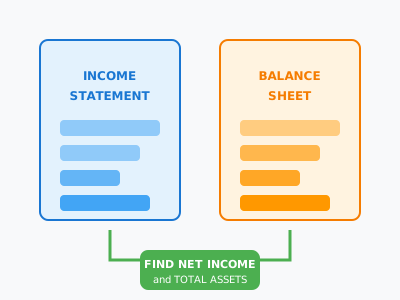
1. Gather Your Financial Data
Find your Net Income from your income statement (this is your profit after all expenses and taxes). Find your Total Assets from your balance sheet (the sum of all current and non-current assets).
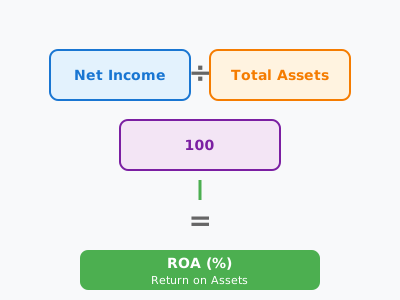
2. Apply the Formula
Divide your Net Income by your Total Assets, then multiply by 100 to convert to a percentage. The formula is: ROA = (Net Income ÷ Total Assets) × 100%. This tells you what percentage return your assets generate.
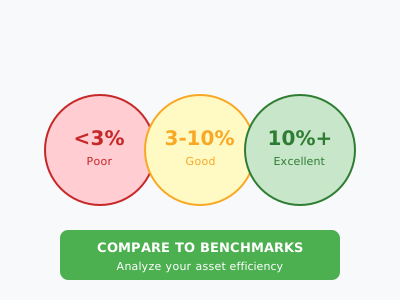
3. Analyze Your Results
A ROA above 5% is generally good. Compare your result to industry benchmarks—asset-intensive industries like manufacturing typically have lower ROA (3-5%), while asset-light sectors like software often achieve 10%+.
What is Return on Assets (ROA)?
I've analyzed the financial performance of hundreds of businesses, and I can tell you that Return on Assets (ROA) is one of the most revealing metrics for measuring operational efficiency. It answers a fundamental question: "How much profit am I squeezing out of every dollar I've invested in assets?"
ROA measures your ability to generate profit from your assets—everything from cash and inventory to equipment, buildings, and intellectual property. It's a powerful measure of asset efficiency. When I see a business with strong ROA, I know management is making smart decisions about capital allocation and squeezing maximum value out of every resource.
I've watched businesses with mediocre sales transform into profitability powerhouses by focusing on ROA. Why? Because they stopped hoarding unproductive assets and started extracting more value from what they already owned. This metric isn't just about profitability—it's about efficiency.
My Understanding of Return on Assets
The ROA tells me what percentage return your business generates from each dollar invested in assets. A ROA of 10% means you're generating 10 cents of profit for every dollar of assets. That's a solid return.
Here's what I've learned from analyzing businesses across different sectors:
- ROA above 10%: Excellent asset efficiency. Common in asset-light businesses like software, consulting, and financial services where you don't need heavy investment in physical assets.
- ROA between 5% and 10%: Good performance. This indicates healthy asset utilization across most industries. You're generating solid returns from your invested capital.
- ROA between 3% and 5%: Adequate but could be better. This is typical for capital-intensive industries like manufacturing, utilities, and transportation. It may indicate room for efficiency improvements.
- ROA below 3%: Poor asset efficiency. Your assets are generating minimal returns. While this might be "normal" in some heavy industries, it often signals operational inefficiency or underutilized assets.
- Negative ROA: Your business is losing money. You're generating losses rather than profits from your assets. This requires immediate attention to turn operations around.
Why I Focus on Industry Context
I've seen business owners panic about their "low" ROA of 4%, not realizing that's perfectly healthy for their manufacturing business. A manufacturer can operate successfully with a 4% ROA because they require massive investment in equipment, facilities, and inventory. A software company with minimal assets might achieve 20% ROA.
When I analyze ROA, I always compare within the same industry. What's exceptional for a heavy equipment manufacturer would be disastrous for a SaaS company. Context is everything.
How to Calculate Return on Assets
The formula is beautifully simple, which is why I love it. Here's exactly how I calculate it:
For more accuracy, you can use Average Total Assets instead of year-end assets:
Let me break down each component:
- Net Income: Your profit after all expenses have been deducted from revenue. This includes operating expenses, interest, and taxes. You'll find this as the "bottom line" on your income statement.
- Total Assets: The sum of everything your business owns or controls that has value. This includes current assets (cash, inventory, receivables) and non-current assets (equipment, buildings, intellectual property). You'll find this at the bottom of the assets section on your balance sheet.
Example Calculation
Let me walk you through a practical example to make this concrete. Suppose we're analyzing a manufacturing business:
The scenario:
- Net Income (profit after taxes): $200,000
- Beginning Total Assets: $4,500,000
- Ending Total Assets: $5,500,000
- Average Total Assets: ($4,500,000 + $5,500,000) ÷ 2 = $5,000,000
Calculation:
ROA = ($200,000 ÷ $5,000,000) × 100% = 4%
Interpretation: This manufacturing business generates a 4% return on its assets. While this might seem low compared to other industries, for a capital-intensive manufacturing business, 4% ROA is actually decent performance. It indicates the company is efficiently using its heavy investment in equipment and facilities to generate profit.
For comparison, a software company with the same $200,000 profit but only $1,000,000 in assets would have a 20% ROA. Both businesses are equally profitable in absolute dollars, but the software company uses its assets more efficiently—though this reflects the fundamentally different business models.
Understanding Your ROA Results
When I analyze ROA, I look for patterns and context. Here's what different ranges typically indicate:
- Negative ROA: Your business is losing money. You're not generating enough profit to cover costs, or you're carrying too many unproductive assets. This is unsustainable in the long run and requires immediate action—either improve profitability or restructure your asset base.
- 0% to 3%: Poor asset efficiency. Your assets are generating minimal returns. While this might be expected in asset-heavy industries like utilities or heavy manufacturing, in most sectors it signals operational problems—excess idle capacity, outdated equipment, poor inventory management, or bloated overhead.
- 3% to 5%: Fair performance. You're generating modest returns from your assets. This is typical for capital-intensive businesses. There may be opportunities to improve efficiency, but you're at least covering your cost of capital in most cases.
- 5% to 10%: Good performance. Your business generates solid returns from its assets. You're using resources efficiently, which indicates effective management and strong operational execution.
- 10% to 15%: Excellent performance. Your asset efficiency is outstanding. You're extracting tremendous value from your invested capital, suggesting superior management and a competitive advantage.
- Above 15%: Exceptional—world-class performance. You're generating industry-leading returns. However, I always verify this is sustainable and not achieved by underinvesting in necessary assets or taking excessive risks.
ROA vs. ROE: What's the Difference?
I often get asked about ROE (Return on Equity). Here's the key difference:
ROA (Return on Assets) measures returns on all assets, regardless of how they're financed (debt or equity). It tells you how efficiently your entire business uses its resources. ROE (Return on Equity) measures returns only on shareholders' equity, ignoring debt-financed assets.
I use both ratios together. ROA tells me about overall operational efficiency—how good you are at using ALL resources (both debt-funded and equity-funded) to generate profit. ROE tells me about returns to owners specifically.
A company can have high ROE but low ROA if it uses aggressive debt leverage. The debt magnifies returns to equity holders (making ROE look great) while the underlying business efficiency (ROA) might be mediocre. That's why I never look at ROE in isolation—ROA provides the reality check.
Industry Benchmark Data
Based on my analysis of publicly traded U.S. companies and industry data from [Eqvista](https://eqvista.com/roa-by-industry/) and [FullRatio](https://fullratio.com/roa-by-industry), here are typical ROA benchmarks by industry:
| Industry / Sector | ROA Range |
|---|---|
| Technology & Software | |
| Software & SaaS | 15-25%+ |
| IT Services | 10-18% |
| Semiconductors | 8-15% |
| Services | |
| Professional Services | 12-20% |
| Financial Services | 10-15% |
| Healthcare Services | 8-14% |
| Retail & Wholesale | |
| Retail (General) | 5-10% |
| E-commerce | 6-12% |
| Wholesale Distribution | 4-8% |
| Manufacturing | |
| Manufacturing (Overall) | 3-6% |
| Food & Beverage Manufacturing | 4-7% |
| Chemical Manufacturing | 3-6% |
| Machinery & Equipment | 2-5% |
| Utilities & Infrastructure | |
| Electric Utilities | 2-4% |
| Gas Utilities | 2-4% |
| Telecommunications | 3-6% |
| Transportation & Logistics | |
| Trucking & Freight | 3-6% |
| Airlines | 1-4% |
| Shipping & Logistics | 3-7% |
| Real Estate & Construction | |
| Real Estate (Development) | 2-5% |
| Construction | 2-5% |
Note: These benchmarks are based on data from publicly traded U.S. companies. Your specific ROA may vary based on your business model, market conditions, asset intensity, and operational efficiency. Top performers often achieve ROAs 50-200% higher than industry averages. Source: [Corporate Finance Institute](https://corporatefinanceinstitute.com/resources/accounting/return-on-assets-roa-formula/)
Strategies I Recommend to Improve Your ROA
If your ROA is lower than you'd like, don't panic—I've helped many businesses dramatically improve their asset efficiency. Here are proven strategies that work:
- Increase Profit Margins:
Higher margins directly boost ROA. I recommend raising prices on premium products, reducing costs through operational improvements, focusing on your highest-margin products/services, and eliminating low-margin offerings that tie up assets without generating adequate returns.
- Improve Asset Utilization:
Squeeze more revenue out of existing assets. For manufacturers, this means reducing downtime and increasing production capacity utilization. For retailers, it means increasing sales per square foot. For everyone, it means finding ways to generate more revenue from the asset base you already have.
- Sell Underperforming Assets:
I've seen businesses hold onto assets that generate minimal returns for sentimental reasons or "just in case." Sell equipment that's rarely used, close underperforming locations, liquidate obsolete inventory, and divest business units that drag down overall ROA.
- Optimize Inventory Levels:
Excess inventory is a ROA killer—it's an asset that ties up capital and generates zero return until sold. Implement just-in-time inventory systems, improve demand forecasting, and aggressively clear out slow-moving stock. Reduce inventory carrying costs while maintaining stock availability.
- Accelerate Accounts Receivable Collection:
Accounts receivable is an asset that doesn't generate returns until converted to cash. Tighten collection policies, offer early payment discounts, and actively follow up on overdue invoices. Faster collection improves your asset turnover and ROA.
- Invest in Higher-Return Assets:
Not all assets are created equal. I recommend investing in assets that generate the highest returns—whether that's new equipment that boosts productivity, software that automates processes, or acquisitions that immediately boost earnings. Focus capital on opportunities with the best ROA potential.
- Reduce Idle Capacity:
Idle assets—whether it's unused manufacturing capacity, vacant office space, or underutilized equipment—destroy ROA. Find ways to utilize these assets (rent out spare capacity, consolidate operations, or sell them entirely).
Common Mistakes I See Businesses Make
In my consulting work, I've watched businesses make predictable errors when managing ROA. Let me share the most common ones so you can avoid them:
- Focusing only on net income, ignoring asset efficiency: I've seen businesses celebrate record profits while ROA declines because they're tying up ever more capital to generate those profits. Growing profits at the expense of asset efficiency isn't sustainable.
- Hoarding assets "just in case": Excess inventory, spare equipment sitting unused, owned real estate that's underutilized—these all destroy ROA. Leaner asset bases generate higher returns.
- Comparing ROA across industries: A software company with 20% ROA isn't necessarily "better" than a manufacturer with 4% ROA. They have completely different business models and asset requirements. Always compare within your industry.
- Inflating ROA by underinvesting: I've seen businesses achieve temporarily high ROA by deferring necessary maintenance, postponing equipment upgrades, or cutting R&D. This is unsustainable—assets eventually need replacement, and deferred maintenance catches up with you.
- Ignoring ROA trends: ROA that's steadily declining is a warning sign, even if it still looks "okay" in absolute terms. Declining ROA signals deteriorating efficiency that needs investigation.
- Forgetting about ROA and only looking at ROE: ROE can look fantastic due to debt leverage, even when the underlying business (ROA) is mediocre. I always analyze both metrics together to get the complete picture.
- Making asset decisions in isolation: Every asset purchase should be evaluated based on its expected impact on ROA. Will this new equipment boost profits enough to justify the capital tied up? If the answer is no, don't buy it.
Why ROA Matters for Your Business
I want to be clear about why this ratio deserves your attention. It's not just about impressing investors—it's about building a fundamentally stronger business:
- Capital efficiency: ROA measures how effectively you turn capital into profit. Businesses with high ROA don't need as much capital to generate the same profit, freeing up cash for other uses or reducing the need for external financing.
- Competitive advantage: Companies with superior ROA have a sustainable competitive advantage. They can outinvest competitors, weather economic downturns, and capture market share from less efficient rivals.
- Investor attractiveness: Whether you're seeking venture capital, bank loans, or planning an IPO, strong ROA signals efficient capital use and management skill. Investors love businesses that generate high returns on capital.
- Strategic decision-making: ROA guides better capital allocation. Should we invest in new equipment? Open a new location? Launch a new product? ROA helps answer these questions by quantifying the return on invested capital.
- Operational excellence indicator: ROA is a comprehensive measure of operational efficiency. High ROA businesses are typically well-managed across multiple dimensions—pricing, cost control, asset utilization, and working capital management.
My Final Thoughts
Return on Assets is one of those deceptively simple metrics that reveals profound insights about your business. It's not just about profitability—it's about efficiency. It tells you how good you are at the fundamental job of business: turning resources into value.
I've seen businesses transform their financial performance by focusing on ROA. They stopped asking "How do we increase sales?" and started asking "How do we generate more profit from the assets we already have?" That shift in thinking—focusing on efficiency, not just growth—changed everything.
Use our free calculator above to check your ROA right now. Then, commit to regular monitoring and continuous improvement. A strong ROA isn't achieved overnight—it's the result of smart capital allocation, efficient operations, and disciplined focus on maximizing the return on every dollar invested in your business.
Remember: the goal isn't to maximize ROA at all costs (which could mean underinvesting in your future). It's to find the right balance between efficiency and investment for your specific business, industry, and stage of growth. Use ROA as a tool for insight and improvement, not as an end in itself.
Frequently Asked Questions
What is a good return on assets (ROA)?
+A good ROA typically falls between 5% and 10%. Above 5% is generally considered healthy for most businesses, while ROA above 10% indicates strong performance. However, "good" varies significantly by industry. Asset-intensive sectors like manufacturing and utilities often have ROA below 5%, while asset-light sectors like software and services can achieve 15% or higher. Always compare your ROA to industry benchmarks, not arbitrary standards.
How do I calculate return on assets?
+The formula is straightforward: ROA = (Net Income ÷ Total Assets) × 100%. Simply take your net income (profit after taxes) from your income statement, divide it by your total assets from your balance sheet, and multiply by 100 to express it as a percentage. For more accuracy, you can use average total assets: [(Beginning Assets + Ending Assets) ÷ 2].
What's the difference between ROA and ROE?
+ROA (Return on Assets) measures how efficiently you use all assets (both debt-funded and equity-funded) to generate profit. ROE (Return on Equity) measures returns only on shareholders' equity. ROA includes the impact of debt, while ROE focuses on returns to owners. A company can have high ROE but low ROA if it uses significant debt leverage. Both metrics together give a complete picture of profitability.
Why is my ROA low?
+A low ROA (below 3-5%) suggests your assets aren' generating sufficient returns. Common causes include: inefficient operations, poor asset utilization, excess idle capacity, outdated equipment, high overhead costs, or low profit margins. In asset-intensive industries, low ROA may be normal, but in other sectors it often indicates operational inefficiency or poor capital allocation decisions.
Can ROA be too high?
+Yes, extremely high ROA (above 20-25%) warrants investigation. While it indicates strong asset efficiency, it could signal: inadequate reinvestment in the business (aging assets), excessive risk-taking, one-time gains distorting the metric, or an asset-light business model that's not sustainable. I always verify high ROA is sustainable and not achieved by underinvesting in necessary assets.
How often should I calculate my ROA?
+I recommend calculating ROA quarterly, at minimum. Asset efficiency trends develop over time, so quarterly calculation helps you spot deteriorating performance early. Many businesses calculate it monthly as part of their financial dashboard. Annual calculation is useful for strategic planning and comparing year-over-year performance, but don't wait that long to monitor this critical metric.
What's included in total assets?
+Total assets include everything your business owns or controls that has value. This includes: current assets (cash, accounts receivable, inventory), non-current assets (property, plant, equipment, machinery, vehicles), intangible assets (patents, trademarks, goodwill), and long-term investments. You'll find total assets at the bottom of the assets section on your balance sheet.
What's included in net income?
+Net income is your profit after all expenses have been deducted from revenue. It includes: operating income (revenue minus operating expenses like COGS, salaries, rent), plus non-operating income/expenses, minus interest expense, minus taxes. Net income is the "bottom line" on your income statement—the profit available to shareholders after all obligations are met.
How does ROA vary by industry?
+ROA varies dramatically by industry due to different asset intensity. Asset-light sectors like software, consulting, and financial services often achieve 10-20%+ ROA. Retail and wholesale typically achieve 5-10%. Asset-heavy sectors like manufacturing, utilities, transportation, and heavy industry often operate below 5% ROA. Always compare your ROA to industry peers—comparing a software company's ROA to a manufacturer's is meaningless.
Why is ROA better than just looking at net income?
+Net income alone doesn't account for the assets required to generate that profit. A company with $10 million in profit might sound successful, but not if it required $500 million in assets to achieve it (2% ROA). ROA measures efficiency—how much profit you squeeze out of each dollar of assets. It's especially valuable for comparing companies of different sizes or evaluating whether new investments will be profitable.
Should I use average assets or year-end assets?
+I recommend using average total assets [(Beginning Assets + Ending Assets) ÷ 2] for more accurate calculation. Assets can fluctuate significantly during the year due to seasonal factors, large purchases, or asset sales. Using average assets smooths out these fluctuations. However, if you only have year-end balance sheet data, year-end assets still provide a reasonable ROA calculation for trend analysis.
How can I improve my ROA?
+I've helped many businesses improve ROA through: (1) increasing profit margins by raising prices, reducing costs, or focusing on higher-margin products, (2) improving asset utilization by increasing production/sales from existing assets, (3) selling underperforming or unnecessary assets, (4) investing in higher-return assets and divesting low-return ones, and (5) reducing idle capacity and inventory. The key is maximizing profit while minimizing assets deployed.